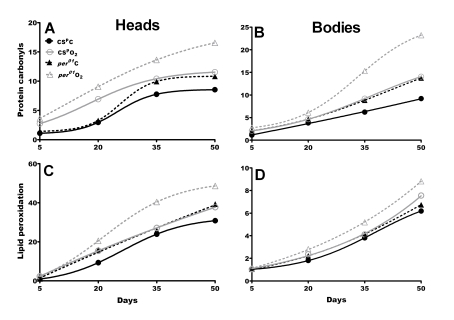
Figure 2.Oxidative damage accumulates to higher levels in aging per01flies.
Fold increase was calculated based on day 5 values in CSp males
under normoxia (numerical values are shown in Supplementary Table 2 and Supplementary Table 3). Top:
Protein carbonyls (PC) in heads (A) and bodies (B) of CSp
(solid line) and per01(broken line) in normoxia (black)
and after hyperoxia (gray). PC levels were significantly higher in per01than in CSp fly heads on day 35 and 50, and on day 50 in
bodies under normoxia. Hyperoxia on day 35 and 50 induced significantly
higher PC levels per01head and bodies compared to CSp
age-matched controls. Bottom: Lipid peroxidation product 4-HNE in
heads (C) and bodies (D). In normoxia, per01flies
accumulated significantly more 4-HNE in heads and bodies compared to CSp
in all ages except day 5. Under hyperoxia, significant increase in 4-HNE
accumulation was observed in per01heads and bodies on
day 20, 35 and 50 compared to CSp males. For statistical
analysis of PC and HNE data refer to Supplementary Table 2 and Supplementary Table 3.