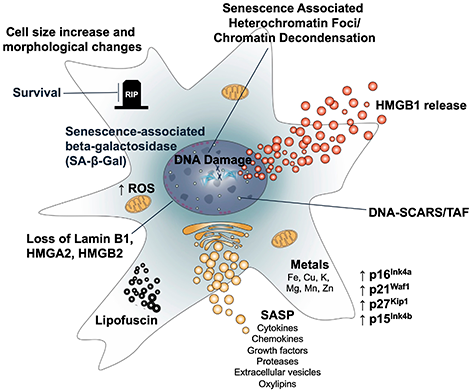
Figure 1.Features of cellular senescence. Senescence is accompanied by multiple features that are both functionally important and can also be used as biomarkers. These include (clockwise): 1. Senescence-associated beta-galactosidase and other lysosomal glycosidases. 2. Persistent cell survival. 3. Increased cell size and a flattened morphology. 4. Epigenetic changes including heterochromatin foci, chromatin decondensation, release of HMGB1, and persistent DNA damage foci (DNA-SCARS), including telomere-associated foci (TAF). 5. Increased cyclin-dependent kinase inhibitors, such as p16, p21, p27, or p15. 6. Accumulation of metals. 7. The SASP, consisting of hundreds of secreted molecules that include inflammatory cytokines and chemokines, growth factors, proteases, extracellular vesicles, and oxylipins. 8. Accumulation of lipofuscin. 9. Nuclear changes, including loss of Lamin B1 and HMGB2. 10. Mitochondrial expansion and dysfunction, including increased mitochondrial mass, ROS, and release of mitochondrial DNA into the cytosol.