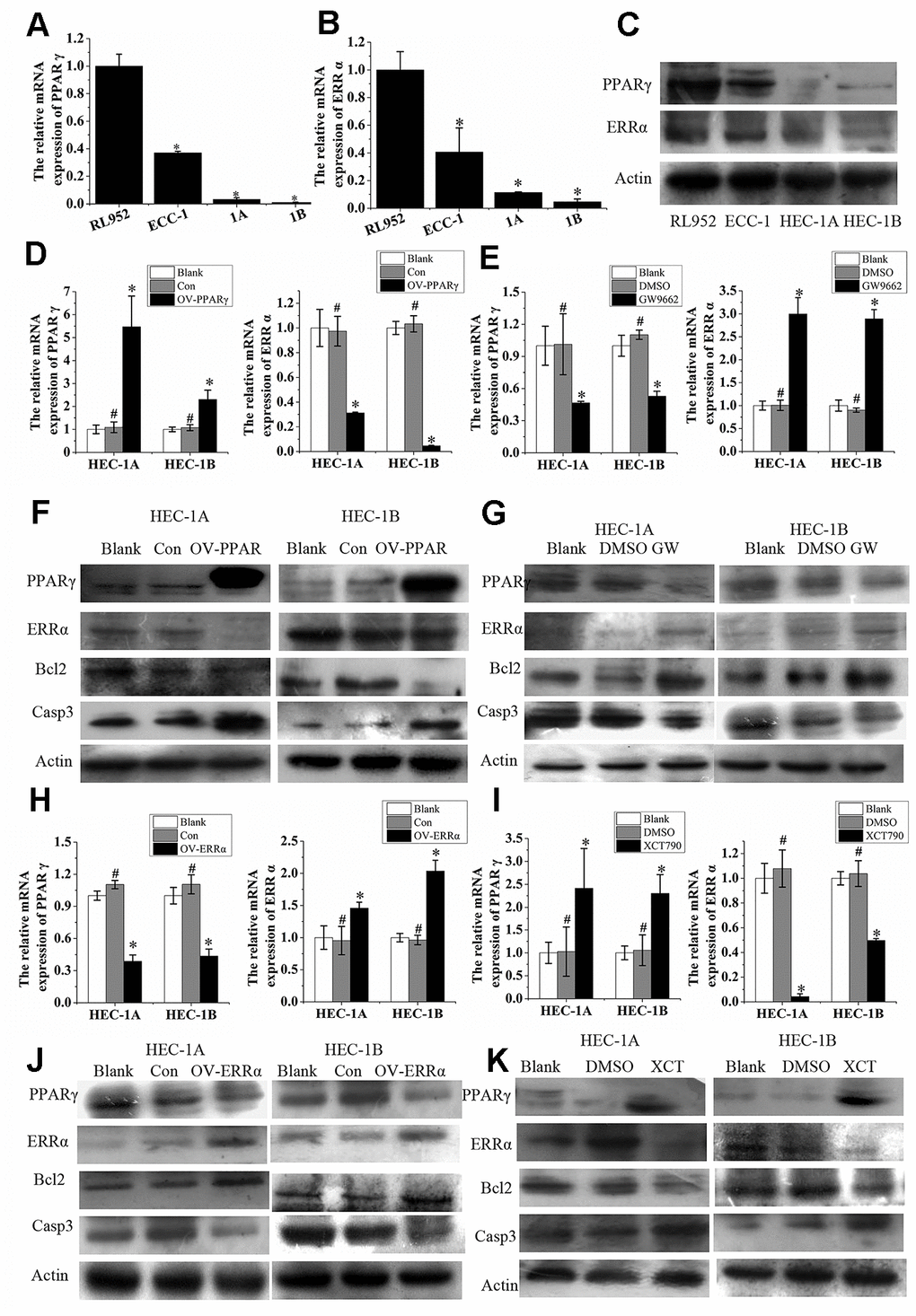
Figure 3.ERRα and PPAR γ negatively regulate each other in EC cells. (A) The relative mRNA expression of PPARγ and (B) the relative mRNA expression of ERRα in RL952, ECC-1, HEC-1A, and HEC-1B cells. (C) Protein expression of PPAR γ and ERRα in RL952, ECC-1, HEC-1A, and HEC-1B cells. (D) Upregulated PPARγ and (E) suppressed PPARγ by GW9662: the relative mRNA expression of PPARγ and ERRα in EC cells. (F) Upregulated PPARγ and (G) suppressed PPARγ by GW9662: the protein expression of PPARγ and ERRα in EC cells. (H) Upregulated ERRα and (I) suppressed ERRα by XCT790: the relative mRNA expression of ERRα and PPARγ in EC cells. (J) Upregulated ERRα and (K) suppressed ERRα by XCT790: the protein expression of PPAR γ and ERRα in EC cells. OV-PPARγ, overexpression of PPARγ. OV-ERRα, overexpression of ERRα. EC, endometrial cancer. *, P<0.05; #, P>0.05.