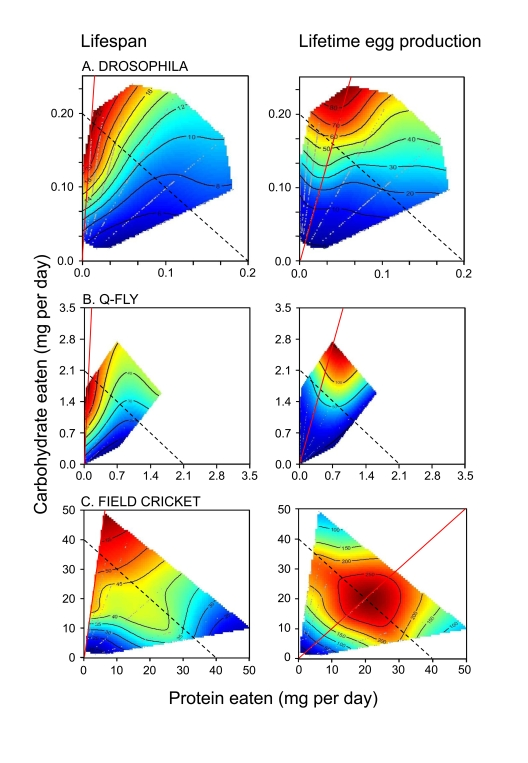
Figure 1.How the intake of protein and carbohydrate influence longevity and lifetime egg production in adults of three insect species. Individuals
were given ad libitum access to one of 28 (Drosophila and the
Queensland fruit fly, Q-fly) or 24 (field cricket) diets varying in the
ratio and total concentration of protein to carbohydrate (P:C). Plotted
onto arrays of points of nutrient intake are fitted surfaces for the two
performance variable, which rise in elevation from dark blue to dark red.
Unbroken red lines indicate the dietary P:C that maximized the response
variable, whereas the dotted lines indicate isocaloric intakes. In each
case, insects lived longest when the diet contained a low P:C, and lifespan
declined as P:C rose. Female reproductive output was maximal on higher P:C
diets than sustained greatest longevity, but fell as P:C rose further, even
at high total energy intakes. Data are replotted from Lee et al. [3]
(Drosophila), Maklakov et al. [11] (field crickets), and Fanson et
al. [4] (Q-fly).