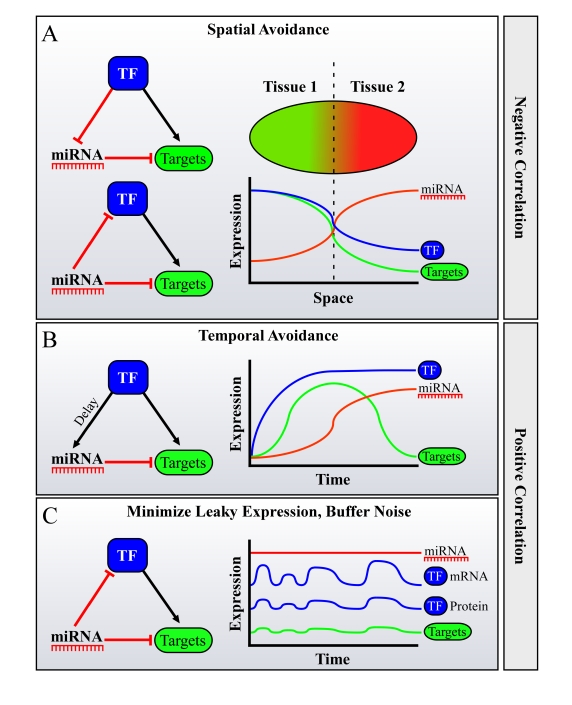
Figure 3.Possible roles for FFLs of miRNAs, Transcription Factors (TFs) and their mutual targets in facilitating spatiotemporal avoidance, or noise buffering.miRNAs are often
embedded in Feed-Forward loops (FFLs) with TFs, sharing mutual targets. It
was shown that in many cases during development, miRNAs and their targets
avoid expression in the same tissue or at the same developmental stage.
This phenome-non was termed "miRNA-target spatiotemporal
avoidance". The figure depicts how the network wiring of miRNAs in
combined transcriptional/posttranscriptional FFLs may explain the spatio-temporal
avoidance phenomenon. Different scenarios may facilitate spatial and
temporal avoidance, where the TF and the miRNA are either negatively
correlated in their expression across tissues (in A) or positively
correlated, namely are expressed in the same tissue (B or C).
(A) Spatial
avoidance may be facilitated by the presented FFLs when expression of a
miRNA and of a TF anti-correlates across tissues. (B) Temporal avoidance
may be facilitated by the presented FFL when a miRNA and a TF are
co-expressed in the same tissues, creating a temporal shut-down mechanism
for their mutual targets, when there is a delay between the activation of
the targets by the TF, and its activation of the miRNA. This delay may be
achieved for example by a lower affinity binding site of the TF to the
miRNA's promoter, by a natural miRNA processing time, etc. (C) Buffering of
noise in expression may also be facilitated by a FFL wiring when a miRNA and
a TF are co-expressed in the same tissues.